This is by far the best presidential campaign video I have seen:
FYI, that was made by a guy named William Adams (he's the first guy you see in the video), not the Obama campaign itself. You can watch Obama's speech here. Transcript here.
Now, if you are like me, you've suffered from low-level clinical depression that mysteriously appeared in November of 2000, that you expected to clear up in November of 2004, but then didn't, and now you expect it to clear up in November of 2008. In fact, if you are like me, you might suspect that GWB is on the payroll of anti-depressant manufacturers seeing as he has done such a great job of drumming up business.
Obama does something here which is so simple but so effective: he shares emotions with people. And the emotion people need the most now is hope. Obama is a master orator, and his speeches absolutely resonate with hopeful emotion (he's not so hot as a debater, to be fair.) If you watch some of MLK's and JFK's old speeches, you will find a very similar style. America is broken, most Americans know that, and we need hope. We need our leaders to understand that.
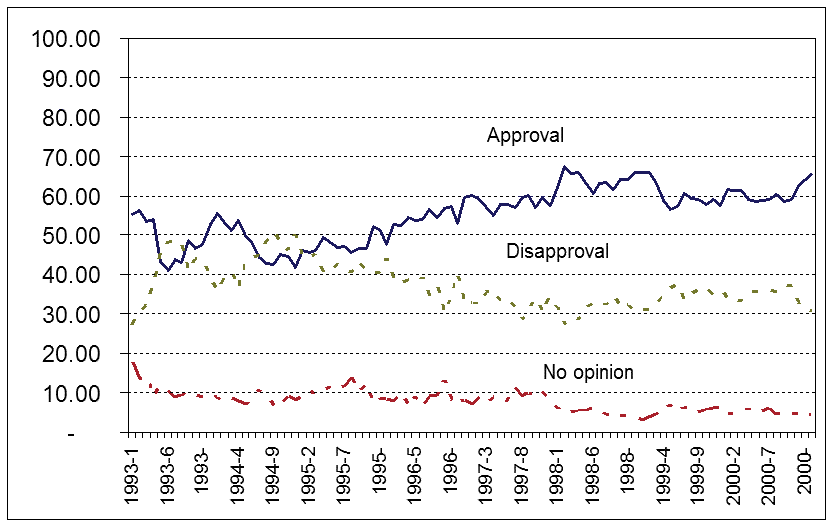
In polls over the last several years, the US Congress (and Vice President) have had an approval rating in the teens, while the President has been in the 30s, "peaking" at 29%. For reference, when Bill Clinton was impeached in 1998, his approval was in the 60s, and in July of 1973, when the Watergate scandal was in full force, Nixon's approval was 39%. America, when compared to the rest of the developed world, has one foot in the crapper, and people don't feel very good about that. Aside from the normal big issues of bitter partisanship, Iraq, the economy, and the environment, we've got a whole lot of other crap going on. Our infant mortality rates are worse than every other developed nation in the world, with the exception of Latvia. Americans consume more cocaine than any other developed nation. We have the highest rates of teen pregnancy and STDs in the developed world (16 times as high as Sweden!) We imprison more of our own citizens by far than any other nation in the world, including Russia and China (both by proportion and absolute figures), and imprison seven times as of our own citizens as most developed nations (by proportion.) Educationally, we are dropping internationally, in K-12 comprehension, college enrolment, and university research output. Only 20% of Americans think the nation is on the right track. As a nation, we are getting downright grumpy.
But Americans are generally good people. I would say overwhelmingly so. And to see all these bad things happen to our country makes us sad, and yearn for hope. Obama sees that, and empathizes. Gore and Kerry saw it, and offered facts and statistics. (Bush doesn't see it at all -- he thinks we're all doing "a heckuva job.") Unfortunately, facts, figures, and policy plans don't win elections, and Democrats are big on presenting statistics and policy minutia. Do you know the only Democratic president in living memory to win re-election? Bill Clinton. Why? He could empathize with people, even if he was a slimeball in certain other regards. But this isn't just my opinion; there is a raft of empirical research showing that leaders (whether they be Presidents or just your boss) who empathize are the ones who are considered successful, facts be damned. The results are always the same: for most people, politics is all about emotion, and particularly emotions tied in with social groups. This has been demonstrated in countless studies conducted in the field, lab studies, and through fMRI scans (when thinking about political candidates, the logic parts of our brains don't light up -- the emotion parts do). Drew Westen, a psychology professor at Emory, has published extensively in this area, and has a good review of the research in The Political Brain (2007) for those who are interested.
Personally, I like facts and figures. Probably a little too much. So when I vote, it comes after a lot of time looking up statistics, checking on old senate votes, and comparing policy proposals. I do this for state elections in states I don't even live in. I realize that makes me about as lame as a two legged horse, but it's how I am. So trust me when I say policy is important. To me, it is all about utilitarianism. But policy does not win elections. Emotional intelligence does. It's a relief to finally see a candidate who can articulate and embrace the nation's feelings, and has a solid policy platform. Fingers crossed for Tuesday!
(Something else that needs to change: I received my absentee ballot just this week -- at least two weeks too late to guarantee arriving in time for Tuesday's primary. You guys will have to vote for me since mine won't be counted.)
Showing posts with label psychology. Show all posts
Showing posts with label psychology. Show all posts
Sunday, 3 February 2008


Thursday, 13 September 2007
Thursday TED: V (Theory of Brain and Artificial Intelligence)
This week's TED talk is by Jeff Hawkins, a big mover behind the handheld computing industry, and a neuroscientist to boot. He asks why is it that after studying the brain for so many decades we still don't have a theory of how it really works? Hawkins says the time is ripe for a paradigm shift in understanding the brain, and once that occurs, artificial intelligence will not be much further down the road.
Thursday, 30 August 2007
Thursday TED: IV (Education, Intelligence, and Creativity)

The note above has been floating around the Internet for about a year now, and although it is probably a hoax, it is most notable because it is so believable. I've witnessed similar instances in high school many times. I've heard it said there are three types of police officers: those who do it because it pays the bills, those who do it to make the world a better place, and those who like the power a little too much. I believe it is the same with teachers. The embittered teachers are only a symptom though; the sad fact is our education system is very broken.
This week's TED is by Sir Ken Robinson about our education system, in particular as to how we conceive of intelligence and creativity. Let's watch:
Ken is right. Our current system is set up so that the ideal student will be trained to be a mini professor. By luck, I am the kind of person our current education system was designed for (and by), and I have personally benefited greatly from this. It's my opinion that professors are pretty neat-o, but professors are still only parts, and parts are only useful when well-integrated into a greater whole. Our current understanding of intelligence - in terms of how our societal institutions define, measure, and encourage it - is staggering in its limitation and its folly.
For more thoughts on the nature of intelligence, and how it is (ill)defined, this short essay by Isaac Asimov is a good starting place.
On a related note, Joshua has recently blogged about this article in Time, entitled Are We Failing Our Geniuses?, which takes a look at those who are currently considered our most gifted - and how they make up 20% of current high school drop outs. Truly, our public education is a shrine to literate mediocrity.
Update: Joshua has a reply to this post.
Wednesday, 29 August 2007
The Mind, the Mushroom, and the Research
About one year ago, an intriguing - and very rare - study was published by researchers at John Hopkins University's Medicine department. It was the world's very first scientifically controlled, double-blind investigation into the effects of psilocybin - the psychoactive ingredient in what are colloquially known as magic mushrooms. Psilocybin had been studied before, but never in such a systematically controlled way, and virtually not at all in recent decades.
The lead researcher Dr. Roland Griffiths, professor of behavioral biology and professor of neuroscience at John Hopkins is no light-weight. His CV is here, and you will note that this study is his 239th journal publication. The goal of this particular study was to investigate the potential of psilocybin as a therapeutic agent, and to better understand the functioning of consciousness, sensory perception, and what may be termed mystical experiences. The participants were 36 well-educated adults with no personal or family history of drug use or mental illness.
What did the researchers find?
In the next few months and years, expect a flurry of follow-up publications. The original research team is currently publishing a 1 year review of the research participants (no word yet on the exact release date). The Griffiths team is also conducting a trial of patients suffering from advanced cancer-related depression or anxiety, as well as designing studies to test a role for psilocybin in treating drug dependence. Researchers at the University of Arizona, UCLA, and Harvard (to name a few) have begun to study psilocybin as a result of this study.
This development is groundbreaking for a number of reasons:
What an exciting time to be a psychologist!
As the relevant publications are released in the coming months, I will provide summaries of the findings here on Exeterra.
The full research report is available here:
Griffiths, R. R., Richards, W. A., McCann, U. & Jesse, R. (2006). Psilocybin can occasion mystical-type experiences having substantial systained personal meaning and spiritual significance. Psychopharmacology, 187, 268-283.
This is a good, accessible press release written without jargon.
And here is commentary by other distinguished researchers in related fields, originally printed in the same edition of Psychopharmacology.
Q & A with the lead researcher, Professor Griffiths.
The lead researcher Dr. Roland Griffiths, professor of behavioral biology and professor of neuroscience at John Hopkins is no light-weight. His CV is here, and you will note that this study is his 239th journal publication. The goal of this particular study was to investigate the potential of psilocybin as a therapeutic agent, and to better understand the functioning of consciousness, sensory perception, and what may be termed mystical experiences. The participants were 36 well-educated adults with no personal or family history of drug use or mental illness.
What did the researchers find?
In the study, more than 60 percent of subjects described the effects of psilocybin in ways that met criteria for a “full mystical experience” as measured by established psychological scales. One third said the experience was the single most spiritually significant of their lifetimes; and more than two-thirds rated it among their five most meaningful and spiritually significant. Griffiths says subjects liken it to the importance of the birth of their first child or the death of a parent.
Two months later, 79 percent of subjects reported moderately or greatly increased well-being or life satisfaction compared with those given a placebo at the same test session. A majority said their mood, attitudes and behaviors had changed for the better. Structured interviews with family members, friends and co-workers generally confirmed the subjects’ remarks.
In the next few months and years, expect a flurry of follow-up publications. The original research team is currently publishing a 1 year review of the research participants (no word yet on the exact release date). The Griffiths team is also conducting a trial of patients suffering from advanced cancer-related depression or anxiety, as well as designing studies to test a role for psilocybin in treating drug dependence. Researchers at the University of Arizona, UCLA, and Harvard (to name a few) have begun to study psilocybin as a result of this study.
This development is groundbreaking for a number of reasons:
- No real scientific research has been conducted on hallucinogens in the last 40 years. We don't really understand how they work, or what effects they have on their users. Hopefully that will change.
- This opens up an entire new range of methods for investigating the fundamentals of how the human mind works. Philosophical questions of the nature of consciousness, mysticism, and self-concept may be addressed from an entirely new scientific approach.
- New treatments for depression, bipolar disorder, drug dependence and other mental illnesses may be available. Anecdotal evidence is very promising in this area, but empirical research is the only conclusive way to test and develop new treatments.
- Government drug policy may finally be adjusted to reflect realistic potentials for abuse. Psilocybin has been condemned by many governments; in the US, it is ranked as a Schedule I drug, along with cocaine and heroin, and possession carries similarly severe penalties of lengthy prison sentences and substantial fines. However, psilocybin is non-toxic (ie, physical overdose is not possible), it is not physically addictive, and there is not a single recorded death caused directly by psilocybin. By contrast, in 1993, tobacco killed 434,000 Americans (20% of all premature US deaths) and alcohol killed 125,000 (Mathias, 1994.)
What an exciting time to be a psychologist!
As the relevant publications are released in the coming months, I will provide summaries of the findings here on Exeterra.
The full research report is available here:
Griffiths, R. R., Richards, W. A., McCann, U. & Jesse, R. (2006). Psilocybin can occasion mystical-type experiences having substantial systained personal meaning and spiritual significance. Psychopharmacology, 187, 268-283.
This is a good, accessible press release written without jargon.
And here is commentary by other distinguished researchers in related fields, originally printed in the same edition of Psychopharmacology.
Q & A with the lead researcher, Professor Griffiths.
Tuesday, 28 August 2007
Mythbusting Monday VI: How Psychics Work
Although we consider many things to be proven - such as the fact that you and I exist - it is vexingly difficult to disprove anything. Can you disprove the existence of unicorns and leprechauns? No, the best we can do is show that there is no support for their existence, but we cannot disprove them. It is always possible that they may exist in some way we cannot detect, improbable as it seems. Likewise, we cannot disprove psychic abilities, but we can demonstrate that there is no support for them. Most of my readers will probably already take that as given, so let's take a look at something a little more interesting: how psychics work.
Psychics use a variety of techniques that borrow from the magicians' repertoire as well as capitalizing on humans' many cognitive biases. In fact, there is a branch of stage magicians called mentalists who perform "psychic" readings while freely admitting that what they do is good-natured chicanery. First, let's take a look at the well-known mentalist Derren Brown as he performs a "seance":
Spooky! But not as spooky as the creeps who use these techniques to exploit vulnerable, grieving people who are desperate for answers. So, how is it done?
Cold Reading: This is a technique where a combination of highly probable guesses and cue reading is used to give the impression that the reader knows something they could not have possibly known. The reader starts (let's say in a seance where there is a large room full of people) by saying, for example, "John, I have a message for you from an old man who loved you dearly." Most large gatherings of people will include a John, and nearly all adults were once close to an old man who is now deceased. The reader then watches the individual's reactions to their probings, and uses very slight reactions to hone in on specifics. A skilled reader can use cold reading very convincingly.
Importantly, not all psychics are intentional fraudsters. Many believe they truly do have paranormal powers to know what other people are thinking. It is most likely that these people are unusually gifted in reading social cues, and have a special ability for reading facial twitches and tones of voice, rather than supernatural powers. As the psychic makes likely guesses, they will become increasingly confident in their "powers" aided by confirmation bias, selective memory, and confabulation.
Wanna know something cool? Even animals have been documented to use a kind of cold reading. Check out Clever Hans, the horse that could do arithmetic.
The Forer Effect: A component of cold reading, but also used in horoscopes and dubious personality tests, the Forer Effect is a cognitive bias where people are likely to interpret statements or predictions as having particular personal relevance. In fact, these statements often apply to just about everybody. In 1948, psychologist Bertram Forer provided research participants each with a "unique personality analysis" which they were asked to rate in terms of accuracy from 1 to 5. The average rating was 4.26, but the "unique personality analysis" was always the same:
The analysis above was created by combining snippets of several horoscopes. The effect has been duplicated by other researchers many times, with most people claiming it to be 80% to 90% accurate.
Let's take another look at Derren, this time using the Forer Effect in a cold reading:
Hot Reading: This is when the reader uncovers private information about the target beforehand, and later uses this to their advantage. Many of the tv-psychics do this by placing microphones in the waiting room. The people who go on those shows usually have particular issues on their mind they are focused on, and will speak to them with other guests while waiting to appear. Then they are shocked, shocked I tell you when the psychic knows of these private concerns. Faith healers have been known to use prayer cards filled in before the show to know the particular afflictions of the sick (through God's grace, of course.) When combined with cold reading, the effect can be very convincing.
Let's take a look at how James Randi, noted mentalist and skeptic, debunks Uri Gellar and Peter Popoff who both used hot reading as well as cold reading (though Uri also uses a lot of standard stage magic.)
Randi has offered a $1,000,000 prize to anyone who can demonstrate psychic abilities under controlled conditions in a lab. To date, there have been over 150 applicants and no winners. You'd think all those psychics working at the 1-900 numbers and the beyond-the-grave tv shows would put their skills to more profitable applications - like taking up Randi on his offer, or predicting stock market trends, or lotto numbers. But no, they're content to have your money instead.
Psychics use a variety of techniques that borrow from the magicians' repertoire as well as capitalizing on humans' many cognitive biases. In fact, there is a branch of stage magicians called mentalists who perform "psychic" readings while freely admitting that what they do is good-natured chicanery. First, let's take a look at the well-known mentalist Derren Brown as he performs a "seance":
Spooky! But not as spooky as the creeps who use these techniques to exploit vulnerable, grieving people who are desperate for answers. So, how is it done?
Cold Reading: This is a technique where a combination of highly probable guesses and cue reading is used to give the impression that the reader knows something they could not have possibly known. The reader starts (let's say in a seance where there is a large room full of people) by saying, for example, "John, I have a message for you from an old man who loved you dearly." Most large gatherings of people will include a John, and nearly all adults were once close to an old man who is now deceased. The reader then watches the individual's reactions to their probings, and uses very slight reactions to hone in on specifics. A skilled reader can use cold reading very convincingly.
Importantly, not all psychics are intentional fraudsters. Many believe they truly do have paranormal powers to know what other people are thinking. It is most likely that these people are unusually gifted in reading social cues, and have a special ability for reading facial twitches and tones of voice, rather than supernatural powers. As the psychic makes likely guesses, they will become increasingly confident in their "powers" aided by confirmation bias, selective memory, and confabulation.
Wanna know something cool? Even animals have been documented to use a kind of cold reading. Check out Clever Hans, the horse that could do arithmetic.
The Forer Effect: A component of cold reading, but also used in horoscopes and dubious personality tests, the Forer Effect is a cognitive bias where people are likely to interpret statements or predictions as having particular personal relevance. In fact, these statements often apply to just about everybody. In 1948, psychologist Bertram Forer provided research participants each with a "unique personality analysis" which they were asked to rate in terms of accuracy from 1 to 5. The average rating was 4.26, but the "unique personality analysis" was always the same:
You have a need for other people to like and admire you, and yet you tend to be critical of yourself. While you have some personality weaknesses you are generally able to compensate for them. You have considerable unused capacity that you have not turned to your advantage. Disciplined and self-controlled on the outside, you tend to be worrisome and insecure on the inside. At times you have serious doubts as to whether you have made the right decision or done the right thing. You prefer a certain amount of change and variety and become dissatisfied when hemmed in by restrictions and limitations. You also pride yourself as an independent thinker; and do not accept others' statements without satisfactory proof. But you have found it unwise to be too frank in revealing yourself to others. At times you are extroverted, affable, and sociable, while at other times you are introverted, wary, and reserved. Some of your aspirations tend to be rather unrealistic.
The analysis above was created by combining snippets of several horoscopes. The effect has been duplicated by other researchers many times, with most people claiming it to be 80% to 90% accurate.
Let's take another look at Derren, this time using the Forer Effect in a cold reading:
Hot Reading: This is when the reader uncovers private information about the target beforehand, and later uses this to their advantage. Many of the tv-psychics do this by placing microphones in the waiting room. The people who go on those shows usually have particular issues on their mind they are focused on, and will speak to them with other guests while waiting to appear. Then they are shocked, shocked I tell you when the psychic knows of these private concerns. Faith healers have been known to use prayer cards filled in before the show to know the particular afflictions of the sick (through God's grace, of course.) When combined with cold reading, the effect can be very convincing.
Let's take a look at how James Randi, noted mentalist and skeptic, debunks Uri Gellar and Peter Popoff who both used hot reading as well as cold reading (though Uri also uses a lot of standard stage magic.)
Randi has offered a $1,000,000 prize to anyone who can demonstrate psychic abilities under controlled conditions in a lab. To date, there have been over 150 applicants and no winners. You'd think all those psychics working at the 1-900 numbers and the beyond-the-grave tv shows would put their skills to more profitable applications - like taking up Randi on his offer, or predicting stock market trends, or lotto numbers. But no, they're content to have your money instead.
Friday, 24 August 2007
Thursday TED: III (Happiness)
This week we'll be taking a look at a presentation by Harvard social Psychologist Dan Gilbert about happiness, specifically something he calls synthetic happiness. I don't know that I would agree with every single one of Gilbert's points, but he does nail many issues squarely on the head: namely, we do a very bad job at knowing what will make us happy. This is, in my opinion, one the more thought-provoking TED presentation... but then, it's probably no surprise that I'm biased towards social psychology.
Thursday, 16 August 2007
Bueller? ... Bueller? ... Bueller?
Those who read Exeterra regularly will know that one of the drums I beat regularly is the need for empirical evidence (ie, real research and real data) to be the basis of our social policy.
This essay by Alfie Kohn makes a research-based critique of the value of homework. According to Kohn, the research is not very supportive. Here's a money shot:
I would add most forms of exams to the list of useless learning aides as well. I can demonstrate this with a thought experiment: think of some times you have studied for a test, be it chemistry, mathematics, history, or anything else. Think of all those things you memorized. Do you remember them now? Did you remember them even one month after the test? What is the point of exams if you forget almost everything once the exam is finished?
This essay by Alfie Kohn makes a research-based critique of the value of homework. According to Kohn, the research is not very supportive. Here's a money shot:
The results of national and international exams raise further doubts. One of many examples is an analysis of 1994 and 1999 Trends in Mathematics and Science Study (TIMSS) data from 50 countries. Researchers David Baker and Gerald Letendre were scarcely able to conceal their surprise when they published their results last year: “Not only did we fail to find any positive relationships,” but “the overall correlations between national average student achievement and national averages in [amount of homework assigned] are all negative.”According to Kohn, (and I should point out this is not my research area) nearly all of the research suggests homework is actually quite harmful to kids, in terms of how they learn, their attitudes towards learning, and their overall well-being. My personal experience supports this.
I would add most forms of exams to the list of useless learning aides as well. I can demonstrate this with a thought experiment: think of some times you have studied for a test, be it chemistry, mathematics, history, or anything else. Think of all those things you memorized. Do you remember them now? Did you remember them even one month after the test? What is the point of exams if you forget almost everything once the exam is finished?
Monday, 6 August 2007
Mythbusting Monday V: People Only Use 10% of Their Brains
First, a few housekeeping issues: You can now email any post on this site by clicking on the envelope icon at the bottom of each post.
Secondly, I've added a function on the right, just below my profile info, which provides you with a randomly selected Deep Thought from Jack Handey each time you load the page (refresh to get a different one.) Currently there are about23 38 53 different ones, but I'll add more as I come across them.
 This week's myth is the old 'you only use 10% (or x%) of your brain.' This myth is more than 100 years old, and has worked its way deep into the imagination largely because most of us have a desire to magically unlock some sort of hidden potential within ourselves, enabling us to effortlessly gain deep wisdom and intelligence. Who wouldn't want that? Unfortunately it has been the selling point used in many pseudoscience/new age systems, promising to enable you to unlock that further 90% for just 4 easy payments of $49.99! (Wow!)
This week's myth is rather fuzzily defined, so we'll approach it from a few different angles. The questions, 'what counts as the brain?' and 'what counts as use?' have more than one interpretation.
First, a short, simple answer: all of your brain is useful and has a known function (100% of it) - though there are also many functions we still don't fully understand. Additionally, most thought processes are very dispersed (processed in many parts of the brain simultaneously). We use all of the brain all of the time, even if the activity level varies - just like we are still 'using' our body when we sit down or sleep.
Now a more detailed answer... So, what counts as the the brain? Well, most people think neurons, and yes, the brain has neurons, but it is actually mostly glial cells (glia being Greek for glue.) In fact, only about 10% of brain cells are actually neurons - the rest are glial cells. But those glial cells are still vitally important - they support the neurons, provide them with nutrients, take away waste, insulate neurons from each others, and are implicated in some thought processes. Neurons would not function without glial cells. This could be one origin of the myth, since only 10% of your brain is neurons, but you still depend on and use that remaining 90%.
What counts as use? One interpretation of use is whether the cell is synaptically active (ie, the neuron is firing.) And indeed, only a small percentage of neurons are firing at any one time. So what would happen if all (or most) of your neurons fired at once? You would have a seizure. In fact, that is exactly what an electrical seizure is. If it happens long enough (and it usually doesn't), you would die. It is the brain equivalent of tensing all your muscles at once - it doesn't make you a super-athlete, it paralyzes you. You don't want to 'unlock' all those remaining neurons at once.
Another interpretation of use is 'potential,' ie, we only use 10% of the brain's potential. This is inherently an unanswerable question, because potential is virtually unknowable. However, our best evidence suggests that this too is poppycock. Most measures of cognitive function show people are actually very similar to each other - we all read at roughly the same speed (200 w/m), and we all have short term memories of about the same size (6 to 8 items). The rare individuals who excel dramatically in one area (for example, mathematics or memory), often have deficits in other areas (social functioning or language), suggesting that these people are not unlocking hidden reserves, but have brains that are specialized in a few areas at the cost of others.
We know the 10% myth is BS, but there are many things you can do to increase your mental performance. However, these involve behaviours and techniques, and do not change how your brains works, but rather take advantage of how it already works.
UPDATE: This is a very well done documentary on autistic savants, particularly Daniel Tammet. Watch it, and be amazed.
Secondly, I've added a function on the right, just below my profile info, which provides you with a randomly selected Deep Thought from Jack Handey each time you load the page (refresh to get a different one.) Currently there are about
 This week's myth is the old 'you only use 10% (or x%) of your brain.' This myth is more than 100 years old, and has worked its way deep into the imagination largely because most of us have a desire to magically unlock some sort of hidden potential within ourselves, enabling us to effortlessly gain deep wisdom and intelligence. Who wouldn't want that? Unfortunately it has been the selling point used in many pseudoscience/new age systems, promising to enable you to unlock that further 90% for just 4 easy payments of $49.99! (Wow!)
This week's myth is rather fuzzily defined, so we'll approach it from a few different angles. The questions, 'what counts as the brain?' and 'what counts as use?' have more than one interpretation.
First, a short, simple answer: all of your brain is useful and has a known function (100% of it) - though there are also many functions we still don't fully understand. Additionally, most thought processes are very dispersed (processed in many parts of the brain simultaneously). We use all of the brain all of the time, even if the activity level varies - just like we are still 'using' our body when we sit down or sleep.
Now a more detailed answer... So, what counts as the the brain? Well, most people think neurons, and yes, the brain has neurons, but it is actually mostly glial cells (glia being Greek for glue.) In fact, only about 10% of brain cells are actually neurons - the rest are glial cells. But those glial cells are still vitally important - they support the neurons, provide them with nutrients, take away waste, insulate neurons from each others, and are implicated in some thought processes. Neurons would not function without glial cells. This could be one origin of the myth, since only 10% of your brain is neurons, but you still depend on and use that remaining 90%.
What counts as use? One interpretation of use is whether the cell is synaptically active (ie, the neuron is firing.) And indeed, only a small percentage of neurons are firing at any one time. So what would happen if all (or most) of your neurons fired at once? You would have a seizure. In fact, that is exactly what an electrical seizure is. If it happens long enough (and it usually doesn't), you would die. It is the brain equivalent of tensing all your muscles at once - it doesn't make you a super-athlete, it paralyzes you. You don't want to 'unlock' all those remaining neurons at once.
Another interpretation of use is 'potential,' ie, we only use 10% of the brain's potential. This is inherently an unanswerable question, because potential is virtually unknowable. However, our best evidence suggests that this too is poppycock. Most measures of cognitive function show people are actually very similar to each other - we all read at roughly the same speed (200 w/m), and we all have short term memories of about the same size (6 to 8 items). The rare individuals who excel dramatically in one area (for example, mathematics or memory), often have deficits in other areas (social functioning or language), suggesting that these people are not unlocking hidden reserves, but have brains that are specialized in a few areas at the cost of others.
We know the 10% myth is BS, but there are many things you can do to increase your mental performance. However, these involve behaviours and techniques, and do not change how your brains works, but rather take advantage of how it already works.
- Use your brain - really challenge yourself until your head hurts. Your brain is like a muscle, and using it keeps it healthy - also like in muscle-building, very hard work gives better results than simple work. In fact, trying hard to solve a puzzle and failing is great for your brain - better than actually solving it. You won't become a genius this way, just like going to the gym won't make you a body-builder, but the effects will be beneficial.
- Take advantage of the automaticity of habits. Once we are habituated to a behaviour, we do it automatically without thinking. Form habits like reading, puzzle solving, and game-playing and you are building in regular brain work-outs with minimal planning effort.
- Use techniques like chunking and mnemonics to boost how much you remember. Also, you remember/understand things better once you have slept - staying up all night to study is a bad idea. There are hundreds of little techniques you can use to get better cognitive results without actually being any smarter.
- Stay physically and emotionally healthy. There is a positive correlation between physical health and mental ability (counter to the unhealthy nerd/dumb athlete stereotype). Aerobic exercise, good nutrition, and adequate sleep are all critical to optimal mental functioning. Exercise is also especially important for emotional balance.
UPDATE: This is a very well done documentary on autistic savants, particularly Daniel Tammet. Watch it, and be amazed.
Sunday, 8 July 2007
Effectiveness in Advertising - An Answer
This is a follow-up on my earlier post Effectiveness in Advertising - A Question. The basic premise of that post was that massive amounts of money is spent on advertising, but that there is little public or common knowledge about how advertising works - or rather there is public knowledge, but it is highly socially constructed knowledge, and is not exactly empirical.
I mentioned a meta-analysis of 389 real world experiments in advertising (Lodish et al, 1995), where they measured the effect of advertising on consumer purchases. Although the results are frustratingly complicated, this is their primary conclusion:
Persuasion is not easy.
Yet we are all too ready to accept the myth that commericals actualy sell products and that educational campaigns really do alter behaviour. Most of the time, it does not even occur to us that these phenomena are questionable in their function. It is a social construction that even the persuaders are unaware of.
Some more examples:
Drug Abuse Resistance Education (DARE) has been tought to 36 million children (including me) in 54 countries. The program is now 24 years old. There is just one problem with it: it doesn't work. Ok, I lied; there are tons of problems with it, but I will focus on the most salient one. I will quote from three research studies:
There is more from West and O'Neal (2004) in a meta-analysis, but it is all the same stuff: DARE doesn't work and sometimes it makes things worse.
DARE has many problems though - such as being rather dishonest in their methods. What about other persuasive campaigns?
Let's take healthy-eating campaigns in schools. The US federal government spends about $1 billion on these every year. But a recent meta-anaylsis of 57 programs found that only 4 showed even a modest increase and the rest had no effect in behavioural change. Uh oh.
What about abstinence-only sex education? This is something the US government has spent over $1 billion on in schools (again, I sat through these in school.) Not only that, Bush (and others) have linked African aid programs to abstinence-only education programs. Teach people how condoms work, and bye-bye funding. But, as you can now guess, these programs do not work. Not only that, teens who take virginity pledges have sex at the same rate as non-pledgers but are less likely to use condoms and more likely to contract STDs. Now that's progress! Let's take a program shown to increase STD rates in the US, and implement it in Africa in the name of reducing HIV/AIDS! Hooray for morality!
On to a topic that is closer to my research efforts - education about the environment has little to no effect in influencing rates of environmental behaviour (recycling, saving energy). Because there are not national-level programs on this, most of these studies are not as high-profile or as publicly documented, but I assure you, they are there. See Clayton and Opotow (2003) for examples of many. Yet environmental NGOs, like the Sierra Club, and local governments still take the education --> behavioural change approach. It does not work.
The take home point: Standard persuasion attempts rarely work, whether in selling products, behavioural changes, or world views. Effects that do occur tend to be blunt and rather uncontrolled. Sometimes they even backfire. This is well documented in hundreds of studies. That's kind of interesting, but the more interesting point is that the persuaders seem to ignore this so doggedly that they almost seem to be consciously suppressing the results, even to the detriment of both their pursestrings and their cause. You would think the advertisers and campaigners would want to know this. The socially negotiated perception of persuasion is so strongly cemented in place that most who march for a cause do so in endless circles in the desert, accomplishing little, victims of a creeping attrition.
Mass influence is possible - but we need to escape our artifical realities of how influence works, to understand how and why.
How exactly that is done is a discussion for another day.
I mentioned a meta-analysis of 389 real world experiments in advertising (Lodish et al, 1995), where they measured the effect of advertising on consumer purchases. Although the results are frustratingly complicated, this is their primary conclusion:
There is no simple correspondence between increased T.V. advertising weight and increased sales, regardless of whether the increased spending is compared to competition or not. ... changing the spending level had little or no impact on sales for established brands.In other words, there is little relation between the time and money spent on t.v. advertising and how much the advertised product actually sells. That is not to say there is no relation - it is complicated and subtle - new products benefit from advertising, and brands that are reinventing themselves benefit from advertising. But in general, for established brands, the effects of advertising are not detectable in terms of sales.
Persuasion is not easy.
Yet we are all too ready to accept the myth that commericals actualy sell products and that educational campaigns really do alter behaviour. Most of the time, it does not even occur to us that these phenomena are questionable in their function. It is a social construction that even the persuaders are unaware of.
Some more examples:
Drug Abuse Resistance Education (DARE) has been tought to 36 million children (including me) in 54 countries. The program is now 24 years old. There is just one problem with it: it doesn't work. Ok, I lied; there are tons of problems with it, but I will focus on the most salient one. I will quote from three research studies:
suburban students who participated in DARE reported significantly higher rates of drug use … than suburban students who did not participate in the program.- from a longitudinal study of 1800 students over six years (Rosenbaum, 1998)
DARE didn’t keep children from using drugs. In fact, it found that suburban kids who took DARE were more likely than others to drink, smoke and take drugs.- from a 1999 study by the California Legislative Analyst's office
Our results are consistent in documenting the absence of beneficial effects associated with the DARE program. This was true whether the outcome consisted of actual drug use or merely attitudes toward drug use. ... The only difference was that those who received D.A.R.E. reported slightly lower levels of self-esteem at age 20.- from a 10-year longitudinal study, N = 1000 (Lynam et al, 1999)
There is more from West and O'Neal (2004) in a meta-analysis, but it is all the same stuff: DARE doesn't work and sometimes it makes things worse.
DARE has many problems though - such as being rather dishonest in their methods. What about other persuasive campaigns?
Let's take healthy-eating campaigns in schools. The US federal government spends about $1 billion on these every year. But a recent meta-anaylsis of 57 programs found that only 4 showed even a modest increase and the rest had no effect in behavioural change. Uh oh.
What about abstinence-only sex education? This is something the US government has spent over $1 billion on in schools (again, I sat through these in school.) Not only that, Bush (and others) have linked African aid programs to abstinence-only education programs. Teach people how condoms work, and bye-bye funding. But, as you can now guess, these programs do not work. Not only that, teens who take virginity pledges have sex at the same rate as non-pledgers but are less likely to use condoms and more likely to contract STDs. Now that's progress! Let's take a program shown to increase STD rates in the US, and implement it in Africa in the name of reducing HIV/AIDS! Hooray for morality!
On to a topic that is closer to my research efforts - education about the environment has little to no effect in influencing rates of environmental behaviour (recycling, saving energy). Because there are not national-level programs on this, most of these studies are not as high-profile or as publicly documented, but I assure you, they are there. See Clayton and Opotow (2003) for examples of many. Yet environmental NGOs, like the Sierra Club, and local governments still take the education --> behavioural change approach. It does not work.
The take home point: Standard persuasion attempts rarely work, whether in selling products, behavioural changes, or world views. Effects that do occur tend to be blunt and rather uncontrolled. Sometimes they even backfire. This is well documented in hundreds of studies. That's kind of interesting, but the more interesting point is that the persuaders seem to ignore this so doggedly that they almost seem to be consciously suppressing the results, even to the detriment of both their pursestrings and their cause. You would think the advertisers and campaigners would want to know this. The socially negotiated perception of persuasion is so strongly cemented in place that most who march for a cause do so in endless circles in the desert, accomplishing little, victims of a creeping attrition.
Mass influence is possible - but we need to escape our artifical realities of how influence works, to understand how and why.
How exactly that is done is a discussion for another day.
Wednesday, 4 July 2007
Effectiveness in Advertising - A Question
This post is based on a general topic I have been thinking quite a lot about recently - the social construction of reality. Given I'm studying to be a social psychologist, that is probably not too surprising. Still, it is strange stuff. Follow me, dear reader, down this dark rabbit hole...
Advertising is ubiquituis. Every day, we see hundreds, if not thousands of advertisements, from places we expect them, like tv and radio, and from less expected places like toilet stalls and roof tops beneath flight paths. But this kind of saturation comes at a price - $144 billion a year is spent on advertising in the US and $385 billion a year is spent worldwide. For the superbowl, advertising costs as much as $5+ million per minute. If I were spending all that money, I'd like to know how effective it is. So it is not very surprising that there have been hundreds of research studies that have sought to discover how effective advertising really is.
I've been reading a meta-analysis (a study of many studies) of 389 real-world studies on the effectiveness of TV advertising. Most of these 389 studies are generally based on advertising a product on tv and then looking to see how much sales change. I found the results rather intriguing. Anyone want to take a guess at how much the typical increase was?
I'll give the study results with explanation on the weekend. Until then, please ponder away. Accurate answers will be rewarded with a pony, possibly a unicorn if the answer is presented in iambic pentameter.
The original paper is:
Lodish, L.M., M. Abraham, S. Kalmenson, J. Livelsberger, B. Lubetkin, B. Richardson, and M.E. Stevens (1995), “How T.V. Advertising Works: A Meta-Analysis of 389 Real World Split Cable T.V. Advertising Experiments,” Journal of Marketing Research, 32 (May), 125–39.
Advertising is ubiquituis. Every day, we see hundreds, if not thousands of advertisements, from places we expect them, like tv and radio, and from less expected places like toilet stalls and roof tops beneath flight paths. But this kind of saturation comes at a price - $144 billion a year is spent on advertising in the US and $385 billion a year is spent worldwide. For the superbowl, advertising costs as much as $5+ million per minute. If I were spending all that money, I'd like to know how effective it is. So it is not very surprising that there have been hundreds of research studies that have sought to discover how effective advertising really is.
I've been reading a meta-analysis (a study of many studies) of 389 real-world studies on the effectiveness of TV advertising. Most of these 389 studies are generally based on advertising a product on tv and then looking to see how much sales change. I found the results rather intriguing. Anyone want to take a guess at how much the typical increase was?
I'll give the study results with explanation on the weekend. Until then, please ponder away. Accurate answers will be rewarded with a pony, possibly a unicorn if the answer is presented in iambic pentameter.
The original paper is:
Lodish, L.M., M. Abraham, S. Kalmenson, J. Livelsberger, B. Lubetkin, B. Richardson, and M.E. Stevens (1995), “How T.V. Advertising Works: A Meta-Analysis of 389 Real World Split Cable T.V. Advertising Experiments,” Journal of Marketing Research, 32 (May), 125–39.
Monday, 2 July 2007
Lying Little Rugrats
I saw an article in the Telegraph that very young children experiment with different forms of deception (via Boing Boing) to get what they want at an age as young as six months or so. When they are this young, they obviously cannot lie with words, but they can do so non-verbally: "Dr Reddy said: 'Fake crying is one of the earliest forms of deception to emerge, and infants use it to get attention even though nothing is wrong. You can tell, as they will then pause while they wait to hear if their mother is responding, before crying again.'"
Ok, pretty interesting stuff. It goes on into more detail of a similar nature, all fairly interesting. But one sentence stuck out to me: "Until now, psychologists had thought the developing brains were not capable of the difficult art of lying until four years old." Excuse me? Has no developmental psychologist ever been around a 2 or 3 year old before? The little devils lie like the dickens, and it is blatantly obvious that they do so. Leave some 2 and 3 year olds to play, wait till a fight starts, then ask "what happened?" and you will hear a profusion of deception. Now developmental psychology is not my expertise, so it could be a newspaper misrepresentation, but gosh golly I hope developmental psychology is further advanced than believing 3 year olds are incapable of deception.
Ok, pretty interesting stuff. It goes on into more detail of a similar nature, all fairly interesting. But one sentence stuck out to me: "Until now, psychologists had thought the developing brains were not capable of the difficult art of lying until four years old." Excuse me? Has no developmental psychologist ever been around a 2 or 3 year old before? The little devils lie like the dickens, and it is blatantly obvious that they do so. Leave some 2 and 3 year olds to play, wait till a fight starts, then ask "what happened?" and you will hear a profusion of deception. Now developmental psychology is not my expertise, so it could be a newspaper misrepresentation, but gosh golly I hope developmental psychology is further advanced than believing 3 year olds are incapable of deception.
Friday, 29 June 2007
Teaching Concluded for the Summer
Today was my last bit of teaching for the summer. I do enjoy teaching, probably even more than research, but it is really considered a kind of a supplement to my "real work," unfortunately. Anyway, this last module was at the Maynard School, for AS-level students (equivalent to Juniors in a US high school). Very keen and very bright students (brighter than many undergrads, to be honest.) It was a 3 week overview of psychology, which made it quite difficult to choose what to cover. How do you cover something as massive as psychology in 3 weeks? And by 3 weeks, I really mean 3 hours, because they were weekly 1 hour sessions. I chose to do 1 on Cognitive, 1 on Social, and 1 on Abnormal. Even then, it's only a small, small fraction of what genuinely deserves classroom attention. I definitely know how my dad feels about rushing through content that begs for a whole semester (at the least) when we can only ration an hour for it.
If you want to have a gander at the presentations, they are available online at my new online resources page: http://people.ex.ac.uk/ccd203 They may be missing something without all the supplementary videos, and explanations behind the bullet points, but if you are interested, there they are.
And now, for the first time since starting my PhD, I have 3 months with no work responsibilities other than my own research. I've already got a stack of journal articles in my backpack...
If you want to have a gander at the presentations, they are available online at my new online resources page: http://people.ex.ac.uk/ccd203 They may be missing something without all the supplementary videos, and explanations behind the bullet points, but if you are interested, there they are.
And now, for the first time since starting my PhD, I have 3 months with no work responsibilities other than my own research. I've already got a stack of journal articles in my backpack...
Monday, 25 June 2007
Slightly Worrying...
In preparation for the high-school level intro to psych classes I am teaching, I have been rereading some of the classic studies in cognition, social psych, and abnormal psych. One of the classics in abnormal psychology is the Rosenhan Experiment.
Psychologist David Rosenhan, in 1972, was concerned about how mental illness was diagnosed and how people were institutionalized. He designed a very elegant study with impeccable ecological validity: he took eight "normal" people (i.e. not insane) and had them visit mental institutions across the US. They acted normally and were totally truthful about themselves, except they also said they heard a voice in their head saying "thud," "empty," and "hollow." The psychiactric staff at the hospital diagnosed seven with schizophrenia and one was diagnosed with bipolar disorder. As soon as they were admitted into the mental hospital all eight researchers acted normally and claimed the voice was gone. The psychiatric staff did not believe them, and insisted they were insane, citing evidence of "psychotic" behaviours by the pseudopatients. Their stays ranged from 7 to 52 days, with a mean age of 19 days before they were allowed to leave. He published his research (On Being Sane in Insane Places) in what is probably the most prestigious academic journal in the world, Science.
When these results were reported, it caused predictable controversy in the world of psychiatry. One prestigious mental hospital boasted that those kinds of mistakes would never happen at their institution, and challenged Rosenhan to send "fake" patients to their institution where they would easily be detected. Rosenhan accepted the challenge. Out of 193 admissions, the institution detected 41 "fakes", and 42 "suspected fakes." How many did Rosenhan send? Zero. Whoops. That kind of research is about as damning as I can think of for an academic discipline. If a discipline is to survive that kind of crisis, it must confront the problem fully and openly, else slip into ever-increasing irrelevance and disregard, until one day it wakes up and find itself nestled snuggly between phrenology and Aristotelian abiogenesis.
Here is the most worrying part: in my 600+ page textbook on Abnormal Psychology, published in 2001, which contains well over 3000 citations, with entire chapters devoted to schizophrenia, diagnosis, and mental institutions, none of Rosenhan's work is mentioned at all. That is a discipline in denial.
(Also worrying is that any genuine discussion on the Internet about the role of psychiatry tends to get hijacked very quickly by militant scientologists.)
Here is a slightly sensationalized, but generally accurate account of the study, originally shown on BBC2's The Trap:
Psychologist David Rosenhan, in 1972, was concerned about how mental illness was diagnosed and how people were institutionalized. He designed a very elegant study with impeccable ecological validity: he took eight "normal" people (i.e. not insane) and had them visit mental institutions across the US. They acted normally and were totally truthful about themselves, except they also said they heard a voice in their head saying "thud," "empty," and "hollow." The psychiactric staff at the hospital diagnosed seven with schizophrenia and one was diagnosed with bipolar disorder. As soon as they were admitted into the mental hospital all eight researchers acted normally and claimed the voice was gone. The psychiatric staff did not believe them, and insisted they were insane, citing evidence of "psychotic" behaviours by the pseudopatients. Their stays ranged from 7 to 52 days, with a mean age of 19 days before they were allowed to leave. He published his research (On Being Sane in Insane Places) in what is probably the most prestigious academic journal in the world, Science.
When these results were reported, it caused predictable controversy in the world of psychiatry. One prestigious mental hospital boasted that those kinds of mistakes would never happen at their institution, and challenged Rosenhan to send "fake" patients to their institution where they would easily be detected. Rosenhan accepted the challenge. Out of 193 admissions, the institution detected 41 "fakes", and 42 "suspected fakes." How many did Rosenhan send? Zero. Whoops. That kind of research is about as damning as I can think of for an academic discipline. If a discipline is to survive that kind of crisis, it must confront the problem fully and openly, else slip into ever-increasing irrelevance and disregard, until one day it wakes up and find itself nestled snuggly between phrenology and Aristotelian abiogenesis.
Here is the most worrying part: in my 600+ page textbook on Abnormal Psychology, published in 2001, which contains well over 3000 citations, with entire chapters devoted to schizophrenia, diagnosis, and mental institutions, none of Rosenhan's work is mentioned at all. That is a discipline in denial.
(Also worrying is that any genuine discussion on the Internet about the role of psychiatry tends to get hijacked very quickly by militant scientologists.)
Here is a slightly sensationalized, but generally accurate account of the study, originally shown on BBC2's The Trap:
Tuesday, 5 June 2007
Explaining the Explanations
I recently started reading Zero-Variable Theories and the Psychology of the Explainer by Robert Wicklund. I'm only on the first chapter, so I can't give any brilliant insights yet, but I think the preface may be one of the most succinct and well delivered I've read. Psychology has so much potential, and many successes, but in so many ways it is just fundamentally crippled. Many of the journal articles, particularly in personality/organizational psych, are just sad; they just do not "get" what psychology is about. And to me, saddest of all is that for most people, this is the only "professional" psychology they come into contact with, often through the distorting simplification of popular print media. Preface is below:
The reader should not suppose that this is a book about the philosophy of social science, or about moral pronouncements on what is good and bad in ancient and current psychological theorizing. Instead, the reader is invited to consider the psychological side of the explainer. What brings individuals, whether they carry the label scientist in psychology or not, to neglect the psychological perspective of those who are being explained? What is responsible for the explainer reducing complex behavioural patterns to “The person is a demagogue type” or “All people from hot climates do that”? And still another question: Are such oversimplifications part of the explainer’s attempt to bring a quick, indelible order to the universe of human behaviour?
The opening chapter introduces the explainer as someone whose directions of explaining are affected by control threats, incompetencies, and lack of experience. Such threats and incompetencies bring the explainer to account for others’ actions by simplifying others, treating them as static entities, with the result that deciding factors in the psychological background are neglected.
Psychology has characteristically limited its explaining of the explainer to the “everyday explainer,” that is, to the so-called naïve scientist. But why not extend our understanding of the explainer to all of those who try to come to terms with complex behaviour including those who carry the label scientist? This book assumes, without reservation, that the principles used to understand “naïve explainers” can be applied just as well to “professional” explainers. Its chapters follow the course of development of the modern theory, as promulgated by scientifically working psychologists, and devote special attention to the narrow thinking that is so evident in recent efforts to capture and explain complex human action. It is shown that modern, widely published explanations manifest a style of theorizing that carries the following characteristics:These fourteen chapters attempt to understand this development in explaining/theorizing, using the broad concepts of the explainer’s commitment to a fixed portrait of the human, the explainer’s control needs with respect to complex human behaviour, and the competition that stems from a field loaded with professional explainers. The final chapter addresses the cultural side of these progressive simplifications and downfalls in theorizing and explanation and comes to the conclusion that a competitive, highly technical society produces the directions that are now explicit in the modern zero-variable theory.
- The humans who are being explained are first placed into fixed categories.
- The explainer implements a single, home-grow categorizing instrument for this purpose.
- These categories consist of lists of behaviours that appear to belong together (e.g., “honest,” “loyal,” “consistent”).
- The behaviours of category members, thus respondents in research projects, are then explained fully by those respondents’ membership in one or the other category.
- The explainer defends the categories as one would defend territory, misusing statistical devices to demonstrate that other explainers cannot account for the behaviours of category members.
- This direction of theory development, referred to here as the zero-variable theory, neglects the perspective of the person whose behaviours are being accounted for and also hinders integration among psychological explanations.
Subscribe to:
Posts (Atom)