This is by far the best presidential campaign video I have seen:
FYI, that was made by a guy named William Adams (he's the first guy you see in the video), not the Obama campaign itself. You can watch Obama's speech here. Transcript here.
Now, if you are like me, you've suffered from low-level clinical depression that mysteriously appeared in November of 2000, that you expected to clear up in November of 2004, but then didn't, and now you expect it to clear up in November of 2008. In fact, if you are like me, you might suspect that GWB is on the payroll of anti-depressant manufacturers seeing as he has done such a great job of drumming up business.
Obama does something here which is so simple but so effective: he shares emotions with people. And the emotion people need the most now is hope. Obama is a master orator, and his speeches absolutely resonate with hopeful emotion (he's not so hot as a debater, to be fair.) If you watch some of MLK's and JFK's old speeches, you will find a very similar style. America is broken, most Americans know that, and we need hope. We need our leaders to understand that.
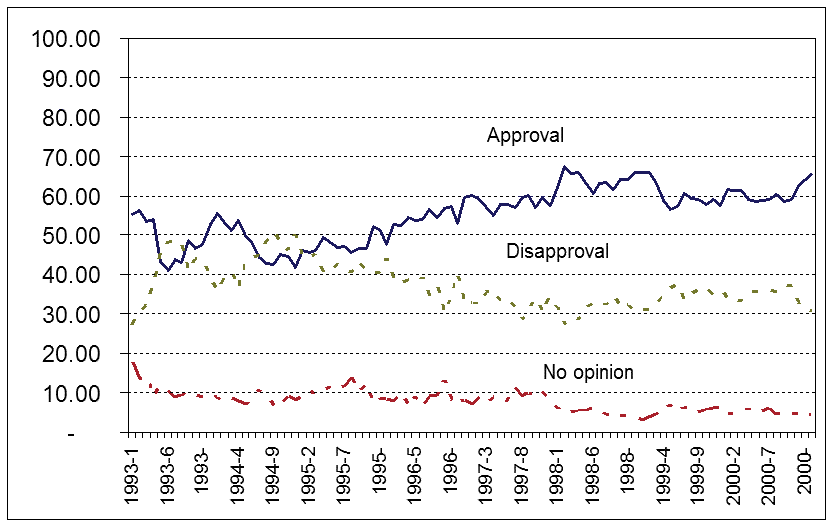
In polls over the last several years, the US Congress (and Vice President) have had an approval rating in the teens, while the President has been in the 30s, "peaking" at 29%. For reference, when Bill Clinton was impeached in 1998, his approval was in the 60s, and in July of 1973, when the Watergate scandal was in full force, Nixon's approval was 39%. America, when compared to the rest of the developed world, has one foot in the crapper, and people don't feel very good about that. Aside from the normal big issues of bitter partisanship, Iraq, the economy, and the environment, we've got a whole lot of other crap going on. Our infant mortality rates are worse than every other developed nation in the world, with the exception of Latvia. Americans consume more cocaine than any other developed nation. We have the highest rates of teen pregnancy and STDs in the developed world (16 times as high as Sweden!) We imprison more of our own citizens by far than any other nation in the world, including Russia and China (both by proportion and absolute figures), and imprison seven times as of our own citizens as most developed nations (by proportion.) Educationally, we are dropping internationally, in K-12 comprehension, college enrolment, and university research output. Only 20% of Americans think the nation is on the right track. As a nation, we are getting downright grumpy.
But Americans are generally good people. I would say overwhelmingly so. And to see all these bad things happen to our country makes us sad, and yearn for hope. Obama sees that, and empathizes. Gore and Kerry saw it, and offered facts and statistics. (Bush doesn't see it at all -- he thinks we're all doing "a heckuva job.") Unfortunately, facts, figures, and policy plans don't win elections, and Democrats are big on presenting statistics and policy minutia. Do you know the only Democratic president in living memory to win re-election? Bill Clinton. Why? He could empathize with people, even if he was a slimeball in certain other regards. But this isn't just my opinion; there is a raft of empirical research showing that leaders (whether they be Presidents or just your boss) who empathize are the ones who are considered successful, facts be damned. The results are always the same: for most people, politics is all about emotion, and particularly emotions tied in with social groups. This has been demonstrated in countless studies conducted in the field, lab studies, and through fMRI scans (when thinking about political candidates, the logic parts of our brains don't light up -- the emotion parts do). Drew Westen, a psychology professor at Emory, has published extensively in this area, and has a good review of the research in The Political Brain (2007) for those who are interested.
Personally, I like facts and figures. Probably a little too much. So when I vote, it comes after a lot of time looking up statistics, checking on old senate votes, and comparing policy proposals. I do this for state elections in states I don't even live in. I realize that makes me about as lame as a two legged horse, but it's how I am. So trust me when I say policy is important. To me, it is all about utilitarianism. But policy does not win elections. Emotional intelligence does. It's a relief to finally see a candidate who can articulate and embrace the nation's feelings, and has a solid policy platform. Fingers crossed for Tuesday!
(Something else that needs to change: I received my absentee ballot just this week -- at least two weeks too late to guarantee arriving in time for Tuesday's primary. You guys will have to vote for me since mine won't be counted.)
Showing posts with label the world. Show all posts
Showing posts with label the world. Show all posts
Sunday, 3 February 2008


Thursday, 1 November 2007
Priorities...
In case anyone forgot, there is still a war on. No wait, make that two wars. You didn't forget about Afghanistan, did you? If anyone needs a refresher on how utterly foolish and wasteful it was to invade Iraq, this graph compares the cost of the war to the amount spent on researching new energy technologies -- something that might actually make the world a universally better place. The units are millions of dollars; figures are from the Department of Energy.

Why can't we provide health care to poor children? "It's too expensive." Why can't we cut toxic emissions? "It's too expensive." Why can't we invest in renewable energy? "It's too expensive."
Uh huh.
The American Friends Service Committee also produces an excellent line of posters which illustrate what a day in Iraq could have been spent on. Print-quality downloads are available from their site.

Why can't we provide health care to poor children? "It's too expensive." Why can't we cut toxic emissions? "It's too expensive." Why can't we invest in renewable energy? "It's too expensive."
Uh huh.
The American Friends Service Committee also produces an excellent line of posters which illustrate what a day in Iraq could have been spent on. Print-quality downloads are available from their site.

Monday, 13 August 2007
The Internet: Documenting Hypocrisy Since 1990
One of the great things about the Internet is that it creates an easily accessible record of everything public officials do. Although there have always been records (old newspaper, old tv footage) it was difficult to access, and once found, difficult to distribute. The Internet changed all of this, particularly the latest incarnation of the Internet. Since 2000, there has been a virtual explosion in online user interactivity, with blogs being a part of this. I am an optimist in the regard that I think the open, interactive, democratic Internet will have a very profound impact on how we think and act, worldwide. It's already starting to change politics, with a number of unscrupulous congressmen losing the last election because their behaviour was recorded and posted to YouTube.
Here is a short example of a very revealing video from April 15, 1994:
The transcript from Editor and Publisher is as follows:
For the curious, the official casualty count so far is 3689 US soldiers (dead), 27,279 US soldiers (maimed), roughly 70,000 Iraqi civilians documented as dead, and an unknown number dead and wounded that have not been documented.
Thanks, Dick.
This picture has made the rounds many times on the Internet, but it's worth seeing again.

This is from Donald Rumsfeld's 1983 trip to Iraq on 19-20 Dec. You can clearly see Rumsfeld and Hussein shaking hands. This trip was made more than a year after Saddam committed the atrocities against the Kurds for which he was executed, and it was widely known at the time that he was using chemical weapons. That did not matter to us at the time. (See here for a detailed timeline with documentation about the US relationship with Saddam in the 1980s.) I do not intend to imply we can never meet with brutal leaders or that we never make mistakes - the issue here is not that Rumsfeld met Hussein; the issue is the reconstruction of history, the elaborate fabrication that we have always opposed Saddam and always wanted to invade Iraq.
Thanks to the Internet, and users who are willing to do a little digging, there can no longer be a memoryhole. As more and more people go online, the more democratic our communication will be.
Here is a short example of a very revealing video from April 15, 1994:
The transcript from Editor and Publisher is as follows:
Q: Do you think the U.S., or U.N. forces, should have moved into Baghdad?
Cheney: No.
Q: Why not?
Cheney: Because if we'd gone to Baghdad we would have been all alone. There wouldn't have been anybody else with us. There would have been a U.S. occupation of Iraq. None of the Arab forces that were willing to fight with us in Kuwait were willing to invade Iraq.
Once you got to Iraq and took it over, took down Saddam Hussein's government, then what are you going to put in its place? That's a very volatile part of the world, and if you take down the central government of Iraq, you could very easily end up seeing pieces of Iraq fly off: part of it, the Syrians would like to have to the west, part of it -- eastern Iraq -- the Iranians would like to claim, they fought over it for eight years. In the north you've got the Kurds, and if the Kurds spin loose and join with the Kurds in Turkey, then you threaten the territorial integrity of Turkey.
It's a quagmire if you go that far and try to take over Iraq.
The other thing was casualties. Everyone was impressed with the fact we were able to do our job with as few casualties as we had. But for the 146 Americans killed in action, and for their families -- it wasn't a cheap war. And the question for the president, in terms of whether or not we went on to Baghdad, took additional casualties in an effort to get Saddam Hussein, was how many additional dead Americans is Saddam worth?
Our judgment was, not very many, and I think we got it right.
For the curious, the official casualty count so far is 3689 US soldiers (dead), 27,279 US soldiers (maimed), roughly 70,000 Iraqi civilians documented as dead, and an unknown number dead and wounded that have not been documented.
Thanks, Dick.
This picture has made the rounds many times on the Internet, but it's worth seeing again.

This is from Donald Rumsfeld's 1983 trip to Iraq on 19-20 Dec. You can clearly see Rumsfeld and Hussein shaking hands. This trip was made more than a year after Saddam committed the atrocities against the Kurds for which he was executed, and it was widely known at the time that he was using chemical weapons. That did not matter to us at the time. (See here for a detailed timeline with documentation about the US relationship with Saddam in the 1980s.) I do not intend to imply we can never meet with brutal leaders or that we never make mistakes - the issue here is not that Rumsfeld met Hussein; the issue is the reconstruction of history, the elaborate fabrication that we have always opposed Saddam and always wanted to invade Iraq.
Thanks to the Internet, and users who are willing to do a little digging, there can no longer be a memoryhole. As more and more people go online, the more democratic our communication will be.
Wednesday, 1 August 2007
Free Our Information
The Technology, Entertainment, Design (TED) conference, is quite simply, fantastic. Every year they have a conference where they have talks and presentations about the coolest ideas coming up, all with the potential to alter how we perceive and interact with the rest of the world. Fortunately, they are all available online. I've only seen a few, but so far they have all been mind-blowing.
The presentation below is by Hans Rosling, and it's about statistics. And it's freakin' sweet! Not in a math-nerd way, but in an everyman way. It's 20 minutes long, and worth every minute.
The most important part of the presentation is the last five minutes. We simply must have a new paradigm of knowledge - of perceiving it and disseminating it. Rosling's presentation is one of the best illustrations I have seen of this. Governments and organizations collect massive amounts of data, and then make it inaccessible. I believe the big revolution of this century will be the liberation of data - the democratization of information. This includes statistics, but more importantly science, entertainment, culture - human knowledge in its entirety. Presently, the producers and masters of human knowledge serve as gatekeepers whose primary role is to create systems which limit access to knowledge. You have to pay dearly to buy books or go to a university. Access to an academic journal often costs $20 per article and are written as to be inaccessible to anyone who has not spent years learning unnecessary jargon. This is no way to promote and disseminate knowledge - it merely keeps knowledge within the elite who are already knowledgeable. Largely, this democratization will occur because of the Internet, but it is much larger than that as well. I believe the impact of liberated data will eventually be on the level of the creation of the printing press, or universal suffrage. It will take time (many decades), and there will be no dramatic news coverage, but the weight of the impact on society will be enormous.
You can download the Trendalyzer software used in the presentation for free.
The presentation below is by Hans Rosling, and it's about statistics. And it's freakin' sweet! Not in a math-nerd way, but in an everyman way. It's 20 minutes long, and worth every minute.
The most important part of the presentation is the last five minutes. We simply must have a new paradigm of knowledge - of perceiving it and disseminating it. Rosling's presentation is one of the best illustrations I have seen of this. Governments and organizations collect massive amounts of data, and then make it inaccessible. I believe the big revolution of this century will be the liberation of data - the democratization of information. This includes statistics, but more importantly science, entertainment, culture - human knowledge in its entirety. Presently, the producers and masters of human knowledge serve as gatekeepers whose primary role is to create systems which limit access to knowledge. You have to pay dearly to buy books or go to a university. Access to an academic journal often costs $20 per article and are written as to be inaccessible to anyone who has not spent years learning unnecessary jargon. This is no way to promote and disseminate knowledge - it merely keeps knowledge within the elite who are already knowledgeable. Largely, this democratization will occur because of the Internet, but it is much larger than that as well. I believe the impact of liberated data will eventually be on the level of the creation of the printing press, or universal suffrage. It will take time (many decades), and there will be no dramatic news coverage, but the weight of the impact on society will be enormous.
You can download the Trendalyzer software used in the presentation for free.
Wednesday, 25 July 2007
Social Policy: It's Time For a MOT
You should all read Ben Goldacre's latest Bad Science article. Ben is one of the leading science warriors of the day - laying waste to pseudofacts and junk science like a level 34 Paladin amongst kobolds.
The basic premise is that social policy - something governments spend hundreds of billions on - is very rarely tested with scientific methods - particularly with controlled, randomized trials. These trials would be easy to do, and not very expensive. They could tell us whether a social policy actually works. If you're going to spend hundreds of billions of pounds/dollars on untested social programs, doesn't it make sense to spend mere millions to see what effect they actually have? Of course, sometimes controlled trials are not feasible for practical or ethical reasons - we can't randomly assign innocent people to prison to see what happens - but we can randomly assign people already in prison to various rehabilitation programs and monitor the varying outcomes of these programs. As always, strict watchdogs will need to ensure the scientific testing process remains ethical, but I believe any risk associated with these trials is far outweighed by the existing danger of present programs. Take DARE, for example. After more than 20 years, many billions in government dollars, and implementing the program on 36 million children, the effects of the program were finally tested. Instead of reducing drug use, it was found the DARE program increased drug use (including alcohol, tobacco, and illegal drugs) and lowered students' self esteem. Great stuff, huh? Now that is unethical. We could have saved a lot of money and a lot of grief if the program had actually been tested at some point previously in those 20 years. What was the conversation like? "Hey Frank, we've used this program on 36 million kids, maybe we should see what effect it has?" "Yeah Bob, you may be on to something."
Ben makes the point that in the recent past doctors opposed using controlled trials to test drugs and medical techniques. When trials finally were introduced it was found that many drugs of the past were in fact useless (hey, remember blood letting?), and often caused horrible unnecessary side-effects. Now it is unthinkable to introduce a new medication without testing its effects. Why are we not testing social policies? They are just as universal and societally relevant as medicine.
The fact that we don't already test social policies is frankly bizarre. It's like we don't want to know whether these programs work or not. Like endorsing a social policy is a matter of faith rather than deliberation. Like we don't want to find out the experts might have been wrong all this time. Thanks, but I'll go for the controlled trials.
The basic premise is that social policy - something governments spend hundreds of billions on - is very rarely tested with scientific methods - particularly with controlled, randomized trials. These trials would be easy to do, and not very expensive. They could tell us whether a social policy actually works. If you're going to spend hundreds of billions of pounds/dollars on untested social programs, doesn't it make sense to spend mere millions to see what effect they actually have? Of course, sometimes controlled trials are not feasible for practical or ethical reasons - we can't randomly assign innocent people to prison to see what happens - but we can randomly assign people already in prison to various rehabilitation programs and monitor the varying outcomes of these programs. As always, strict watchdogs will need to ensure the scientific testing process remains ethical, but I believe any risk associated with these trials is far outweighed by the existing danger of present programs. Take DARE, for example. After more than 20 years, many billions in government dollars, and implementing the program on 36 million children, the effects of the program were finally tested. Instead of reducing drug use, it was found the DARE program increased drug use (including alcohol, tobacco, and illegal drugs) and lowered students' self esteem. Great stuff, huh? Now that is unethical. We could have saved a lot of money and a lot of grief if the program had actually been tested at some point previously in those 20 years. What was the conversation like? "Hey Frank, we've used this program on 36 million kids, maybe we should see what effect it has?" "Yeah Bob, you may be on to something."
Ben makes the point that in the recent past doctors opposed using controlled trials to test drugs and medical techniques. When trials finally were introduced it was found that many drugs of the past were in fact useless (hey, remember blood letting?), and often caused horrible unnecessary side-effects. Now it is unthinkable to introduce a new medication without testing its effects. Why are we not testing social policies? They are just as universal and societally relevant as medicine.
The fact that we don't already test social policies is frankly bizarre. It's like we don't want to know whether these programs work or not. Like endorsing a social policy is a matter of faith rather than deliberation. Like we don't want to find out the experts might have been wrong all this time. Thanks, but I'll go for the controlled trials.
Friday, 1 June 2007
All Your Gum Arabic Are Belong To Us
In what was one of the most bizzare press conferences ever, John Ukec Lueth Ukec ("Khartoum Karl"), the Sudanese ambassador to the US, responded to the recent sanctions placed against Sudan because of the, you know, mass genocide and stuff.
There are too many strange things to point out all of them in his hour-long vomit-fest of craziness, but perhaps the most amusing was that he threatened to take away the world's supply of Coca-Cola if people kept accusing Sudan of genocide.
From the Washington Post:
These are some highlights from the hour-long performance:
There are too many strange things to point out all of them in his hour-long vomit-fest of craziness, but perhaps the most amusing was that he threatened to take away the world's supply of Coca-Cola if people kept accusing Sudan of genocide.
From the Washington Post:
Genocide in the Darfur region? "The United States is the only country saying that what is happening in Darfur is a genocide," Ukec shouted, gesticulating wildly and perspiring from his bald crown. "I think this is a pretext."
Ah. So what about the more than 400,000 dead? "See how many people are dying in Darfur: None," he said.
And the 2 million displaced? "I am not a statistician."
Khartoum Karl went on to say that, all evidence to the contrary, his government does not support the murderous Janjaweed militia. "It cannot happen," he said, "so rule it out." As for the Sudanese regime itself: "We are the agents of peace, people like me, my colleagues who are in the central government of Sudan."
What's more, the good and peaceful leaders of Sudan were prepared to retaliate massively: They would cut off shipments of the emulsifier gum arabic, thereby depriving the world of cola.
"I want you to know that the gum arabic which runs all the soft drinks all over the world, including the United States, mainly 80 percent is imported from my country," the ambassador said after raising a bottle of Coca-Cola.
A reporter asked if Sudan was threatening to "stop the export of gum arabic and bring down the Western world."
"I can stop that gum arabic and all of us will have lost this," Khartoum Karl warned anew, beckoning to the Coke bottle. "But I don't want to go that way."
These are some highlights from the hour-long performance:
Tuesday, 29 May 2007
Meet the New History, Same as the Old History
So, which is worse, bad tv shows or good tv shows?
Bad tv shows, which are 90%+ of what is on, are a reflection of our own failed aspirations, a sign of the crumbling ediface of society, yada, yada, yada... but at least we can be satisfied in our refusal to watch them. We can actually use our time productively.
Good tv shows, which are rare, show us real achievements in communication, education, and acting. They allow us to be proud of sitting on the sofa. But they can also suck away inordinate amounts of time, especially if they are running in a marathon.
The reason I bring this up is the near-constant lineup of top-quality historical documentaries that have been on television here lately. First, there was the World At War series on about a month ago. Produced from 1969 to 1973, this is a 26 hour long documentary about World War 2 comprised entirely of primary-source video footage and interviews. There were no computer animations, no poorly executed gauzy dramatizations, and no gloating narration (these are the hallmarks of the modern war documentary.) World at War is sober and powerful. The interviews are from civilians of many nations, holocaust survivors, soldiers and officers from all sides, even lords and generals from both Allied and Axis nations. The footage shows the mass graves, the flies, the bloated corpses that lie in the road. It's as sad and as unnecessary as hell, but that is the point. War is sad; war is unnecessary; most of all, war is hell. Truth this raw is rarely in our living rooms.
Now there is a weeklong-plus marathon of documentaries about ancient Rome that started yesterday. Don't you people know I have work to do?! While not as profound as The World at War, so far it is still very well done. They are presented as a series of historical dramas about particular individuals. The acting is reasonable, the stories are not sensationalized, it does not give in to popular villianization, and when the historical record runs thin, this is acknowledged. They do not give in to the myths of popular history - they acknowledge that Nero was in Antium during during the Great Fire of Rome (at least, according to Tacitus) and therefore could not be fiddling while Rome burned (never mind that the fiddle would not be invented for another 1000 years... but I digress). The series is by no means what I would call scholarly, but for something that is aimed at a general audience, it is fetching both in terms of education and entertainment.
While history is wonderful in its own right, there is a reason I mention these shows. Let me explain...
Last week, the BBC presented an edition of This World titled Mystery Flights. It is a rather frightening look at how "terrorism suspects" have been rendered from the US to secret Eastern European facilities to be tortured. This is not conspiracy-theory stuff: they have interviews with the people who were tortured; they have pictures of the facilities; they even have an interview with the former CIA chief in Europe who resigned over the torture that was occuring. By the way, if you are wondering why this is a big deal (I hope you're not!) it is because it violates, oh, a couple of hundred laws, both national and international, in the US and the EU, and the people who authorized it are, according to all parties' national laws at least, guilty of war crimes. For the next few days, you can watch the entire show, but only for a few more days (non-UK viewers may not be able to access it).
Learning history makes one realize just how little humans change. Our present world leaders are little different from the world leaders in the 1940s, the Iron Age 40s, or any other decade you would like to choose. Our surroundings may change, and that may make people seem like they are different, but is only an environmental effect. The essential human never changes. Like a steady candle flame, humans are billions of points of energy, colliding violently, always moving, consuming and combusting, yet through the chaos, they maintain the exact same shape of the flame.
History is the flip-side of lab-based psychology. Although under-appreciated as a duo, they complement each other very well. I highly recommend both.
Update: So far the Roman shows have been pretty good - it seems like the marketers got a little too hyped, the show on the Colliseum being called "Arena of Death," but in the actual show they mention that death in the colliseum was actually very rare.
But what I found most interesting is that in the docudrama about Hannibal, Hannibal is played by Alexander Siddig (his birth name is Siddig El Tahir El Fadil El Siddig Abderahman Mohammed Ahmed Abdel Karim El Mahdi.) He is probably best known as playing Dr. Bashir in Star Trek: Deep Space Nine. Very strange to see the good (but awkward) Doctor lead the forces of Carthage against the Roman legions at Cannae.


Bad tv shows, which are 90%+ of what is on, are a reflection of our own failed aspirations, a sign of the crumbling ediface of society, yada, yada, yada... but at least we can be satisfied in our refusal to watch them. We can actually use our time productively.
Good tv shows, which are rare, show us real achievements in communication, education, and acting. They allow us to be proud of sitting on the sofa. But they can also suck away inordinate amounts of time, especially if they are running in a marathon.
The reason I bring this up is the near-constant lineup of top-quality historical documentaries that have been on television here lately. First, there was the World At War series on about a month ago. Produced from 1969 to 1973, this is a 26 hour long documentary about World War 2 comprised entirely of primary-source video footage and interviews. There were no computer animations, no poorly executed gauzy dramatizations, and no gloating narration (these are the hallmarks of the modern war documentary.) World at War is sober and powerful. The interviews are from civilians of many nations, holocaust survivors, soldiers and officers from all sides, even lords and generals from both Allied and Axis nations. The footage shows the mass graves, the flies, the bloated corpses that lie in the road. It's as sad and as unnecessary as hell, but that is the point. War is sad; war is unnecessary; most of all, war is hell. Truth this raw is rarely in our living rooms.
Now there is a weeklong-plus marathon of documentaries about ancient Rome that started yesterday. Don't you people know I have work to do?! While not as profound as The World at War, so far it is still very well done. They are presented as a series of historical dramas about particular individuals. The acting is reasonable, the stories are not sensationalized, it does not give in to popular villianization, and when the historical record runs thin, this is acknowledged. They do not give in to the myths of popular history - they acknowledge that Nero was in Antium during during the Great Fire of Rome (at least, according to Tacitus) and therefore could not be fiddling while Rome burned (never mind that the fiddle would not be invented for another 1000 years... but I digress). The series is by no means what I would call scholarly, but for something that is aimed at a general audience, it is fetching both in terms of education and entertainment.
While history is wonderful in its own right, there is a reason I mention these shows. Let me explain...
Last week, the BBC presented an edition of This World titled Mystery Flights. It is a rather frightening look at how "terrorism suspects" have been rendered from the US to secret Eastern European facilities to be tortured. This is not conspiracy-theory stuff: they have interviews with the people who were tortured; they have pictures of the facilities; they even have an interview with the former CIA chief in Europe who resigned over the torture that was occuring. By the way, if you are wondering why this is a big deal (I hope you're not!) it is because it violates, oh, a couple of hundred laws, both national and international, in the US and the EU, and the people who authorized it are, according to all parties' national laws at least, guilty of war crimes. For the next few days, you can watch the entire show, but only for a few more days (non-UK viewers may not be able to access it).
Learning history makes one realize just how little humans change. Our present world leaders are little different from the world leaders in the 1940s, the Iron Age 40s, or any other decade you would like to choose. Our surroundings may change, and that may make people seem like they are different, but is only an environmental effect. The essential human never changes. Like a steady candle flame, humans are billions of points of energy, colliding violently, always moving, consuming and combusting, yet through the chaos, they maintain the exact same shape of the flame.
History is the flip-side of lab-based psychology. Although under-appreciated as a duo, they complement each other very well. I highly recommend both.
Update: So far the Roman shows have been pretty good - it seems like the marketers got a little too hyped, the show on the Colliseum being called "Arena of Death," but in the actual show they mention that death in the colliseum was actually very rare.
But what I found most interesting is that in the docudrama about Hannibal, Hannibal is played by Alexander Siddig (his birth name is Siddig El Tahir El Fadil El Siddig Abderahman Mohammed Ahmed Abdel Karim El Mahdi.) He is probably best known as playing Dr. Bashir in Star Trek: Deep Space Nine. Very strange to see the good (but awkward) Doctor lead the forces of Carthage against the Roman legions at Cannae.


Friday, 4 May 2007
Socially Responsible Design
The International Herald Tribune has a piece up on some of the best socially responsible design products. The basic idea is that most products are designed for the wealthiest 10% of the world, and the remaining 90% just struggles to survive. Yet their burden would be much lighter with some simple technological innovation, like electricity-free refrigeration, cheap water purifiers, and cylindrical 75 litre water jugs that can be pulled by a child. As August Pollak says, some of these are "such an obvious design that it's almost painful to consider how no one thought of it until now."
So I was reading through this list, thinking all these ideas were pretty cool when, completely unexpectedly, I found an item I personally helped build (page 13.) The Mad Housers are a group of socially minded engineers who build ultra-cheap houses for homeless people in Atlanta. Each house has a locking door, a loft for sleeping, and a wood/charcoal powered stove for heating and cooking. They cost no more than a few hundred dollars per house. The idea is that many homeless people could drag themselves out of poverty if given some stability and privacy - and indeed most of the people given one of these houses are not homeless for very long. Anyway, I got involved with them during college, and helped build a few houses with them. The house pictured in the article looks exactly like one of the ones I helped build (though it may be a similar different one.)
The Internet is a small world indeed.
So I was reading through this list, thinking all these ideas were pretty cool when, completely unexpectedly, I found an item I personally helped build (page 13.) The Mad Housers are a group of socially minded engineers who build ultra-cheap houses for homeless people in Atlanta. Each house has a locking door, a loft for sleeping, and a wood/charcoal powered stove for heating and cooking. They cost no more than a few hundred dollars per house. The idea is that many homeless people could drag themselves out of poverty if given some stability and privacy - and indeed most of the people given one of these houses are not homeless for very long. Anyway, I got involved with them during college, and helped build a few houses with them. The house pictured in the article looks exactly like one of the ones I helped build (though it may be a similar different one.)
The Internet is a small world indeed.
Saturday, 7 April 2007
Microlending
What is microlending?
You've probably heard the saying "Give someone a carrot and you feed them for a day. Give them some carrot seed and a spade and you feed them for a lifetime." Er, or something like that. And you've probably also heard "you have to have money to make money."
Microlending is the combination and extension of these two aphorisms. The poorest of the poor are given small loans (typically under $100) which allows them to buy the tools they need to support themselves, typically something like a sewing machine, or a pottery wheel, or farming tools. It is not charity in the usual sense; they do have to pay the money back, with a small amount of interest. Traditional banks wouldn't want to touch these people: they have no property, no collateral, no hope. Or so it would seem. Microborrowers actually pay back their loans at about the same rate as we wealthy Westerners typically do, even though they typically have no material collateral.
Microlending has been one of the biggest success stories in the struggle against poverty, especially for women. As far as value-for-effort, I would say microlending and Fair Trade are the two most successful anti-poverty programs since decolonization. Both are spreading at rapid speed, and it is now becoming possible for Western individuals to make more of a personal contribution in these kinds of programs. But with so many new programs, how are they different? Which make best use of their money?
Slate has a helpful semi-systematic review of many microlending programs, kind of like a Consumer Reports of charitable lenders, giving detailed comments about the best and worst aspects of individual programs. Very useful to the discerning donor, and the recipients as well.
You've probably heard the saying "Give someone a carrot and you feed them for a day. Give them some carrot seed and a spade and you feed them for a lifetime." Er, or something like that. And you've probably also heard "you have to have money to make money."
Microlending is the combination and extension of these two aphorisms. The poorest of the poor are given small loans (typically under $100) which allows them to buy the tools they need to support themselves, typically something like a sewing machine, or a pottery wheel, or farming tools. It is not charity in the usual sense; they do have to pay the money back, with a small amount of interest. Traditional banks wouldn't want to touch these people: they have no property, no collateral, no hope. Or so it would seem. Microborrowers actually pay back their loans at about the same rate as we wealthy Westerners typically do, even though they typically have no material collateral.
Microlending has been one of the biggest success stories in the struggle against poverty, especially for women. As far as value-for-effort, I would say microlending and Fair Trade are the two most successful anti-poverty programs since decolonization. Both are spreading at rapid speed, and it is now becoming possible for Western individuals to make more of a personal contribution in these kinds of programs. But with so many new programs, how are they different? Which make best use of their money?
Slate has a helpful semi-systematic review of many microlending programs, kind of like a Consumer Reports of charitable lenders, giving detailed comments about the best and worst aspects of individual programs. Very useful to the discerning donor, and the recipients as well.
Thursday, 5 April 2007
On Beauty
Sorry to go all video-crazy, but I feel these are worth sharing.
Some of you may have heard of Dove's Real Beauty Campaign. It has gathered quite some momentum online, having been viewed on YouTube millions of times, and distributed through the blogosphere. This is the ad:
What do you think? It's generated a huge amount of feedback worldwide.
Now compare it to this advert:
Although I don't speak Hindi, I know exactly what the message is: you only matter if you are beautiful, and you're only beautiful if you are not dark. (As an aside, the "dark" woman in the advert starts off being far lighter than most Indian people.) And although the advert is undeniably sexist, women are not the only target (click link to view.)
So what do you think of those last two? Compared to the first one? What a world of contrast.
Now here is the catch: all three advertisements are made by the same company (Unilever.) Dove and Fair and Lovely are products of the same people. Dove's "Self-Esteem Fund" and "Campaign for Real Beauty" are made by the same company who make "Fair and Lovely" skin lightener, and who explicitly say brown is ugly.
"No wonder our perceptions of beauty are distorted."
Chew on that for a while. I don't know that there is a single take-home message here, but two stick out to me:
1) Always be skeptical of advertisements.
2) It is possible to do good whilst also doing bad, and in fact most of the good done in the world is done by people who are also doing a lot of bad. Purity does not exist.
I would also like to point out that these adverts were uploaded to YouTube by the producers of the adverts themselves, suggesting they feel it is appropriate to reach as wide an audience as possible with the "brown is ugly" message.
Before leaving you, I would like to share this joyful gem, completely unrelated to the rest of the post, but also from India.
Hat tip to Sita for the last video. It has brought tears to my eyes with laughter more than once.
Some of you may have heard of Dove's Real Beauty Campaign. It has gathered quite some momentum online, having been viewed on YouTube millions of times, and distributed through the blogosphere. This is the ad:
What do you think? It's generated a huge amount of feedback worldwide.
Now compare it to this advert:
Although I don't speak Hindi, I know exactly what the message is: you only matter if you are beautiful, and you're only beautiful if you are not dark. (As an aside, the "dark" woman in the advert starts off being far lighter than most Indian people.) And although the advert is undeniably sexist, women are not the only target (click link to view.)
So what do you think of those last two? Compared to the first one? What a world of contrast.
Now here is the catch: all three advertisements are made by the same company (Unilever.) Dove and Fair and Lovely are products of the same people. Dove's "Self-Esteem Fund" and "Campaign for Real Beauty" are made by the same company who make "Fair and Lovely" skin lightener, and who explicitly say brown is ugly.
"No wonder our perceptions of beauty are distorted."
Chew on that for a while. I don't know that there is a single take-home message here, but two stick out to me:
1) Always be skeptical of advertisements.
2) It is possible to do good whilst also doing bad, and in fact most of the good done in the world is done by people who are also doing a lot of bad. Purity does not exist.
I would also like to point out that these adverts were uploaded to YouTube by the producers of the adverts themselves, suggesting they feel it is appropriate to reach as wide an audience as possible with the "brown is ugly" message.
Before leaving you, I would like to share this joyful gem, completely unrelated to the rest of the post, but also from India.
Hat tip to Sita for the last video. It has brought tears to my eyes with laughter more than once.
Wednesday, 21 March 2007
Zimbabwe
 Two years ago I met a student at Berry who was a refugee from Zimbabwe. His family's land had been seized by armed robbers, and most of the people he had known had also fled or had been killed.
Unfortunately, this is not a rare story. It's estimated that one out of every 200 people in Britain right now is a refugee from Zimbabwe. For a long time, Zimbabwe's long, slow death was mostly unseen in the US and UK, but now that is starting to change.
Recently, the ruler Robert Mugabe arrested most of the leadership of the opposition party and did very bad things to them (I won't post the pictures; they're pretty horrific.) This has been playing on the news quite a bit here; not as much as, say, cricket, but a lot more than ever before. Ten years ago, Zimbabwe was a relatively prosperous nation that exported food and resources to much of southern Africa, and was steadily improving. Today, the average life expectancy is the lowest in the world, 37 years for men and 34 years for women; unemployment is at 80%; and inflation is the highest in the world, often topping 1000% per month. What happened? There was no foreign invader, no civil war, no devastating natural disaster. It was sheer mismanagement by the head of government.
All of this now seems to be converging in the international consciousness. Zimbabwe's neighbours seem to be waking up to the reality that this is a Big Problem, and they will need to do something soon before it becomes Their Problem as well. In Zimbabwe itself, people seem to be losing their fear of opposition, as they have little left to lose. Even more, many of the police seem to increasingly resist being used as tools of political violence, a job most of them did not sign up for.
It is impossible to predict what will happen in the near future with any accuracy, but the feeling is high that something will happen, whether internal revolution, external intervention, or the old bugger just finally dies (he's 83). I think it will definitely get worse before it is over, but the end of Zimbabwe's long national nightmare finally seems imminent.
The upside: an enterprising company in Canada has struck back in the only way it knows how: Mugabe Wipes!

Subscribe to:
Posts (Atom)